

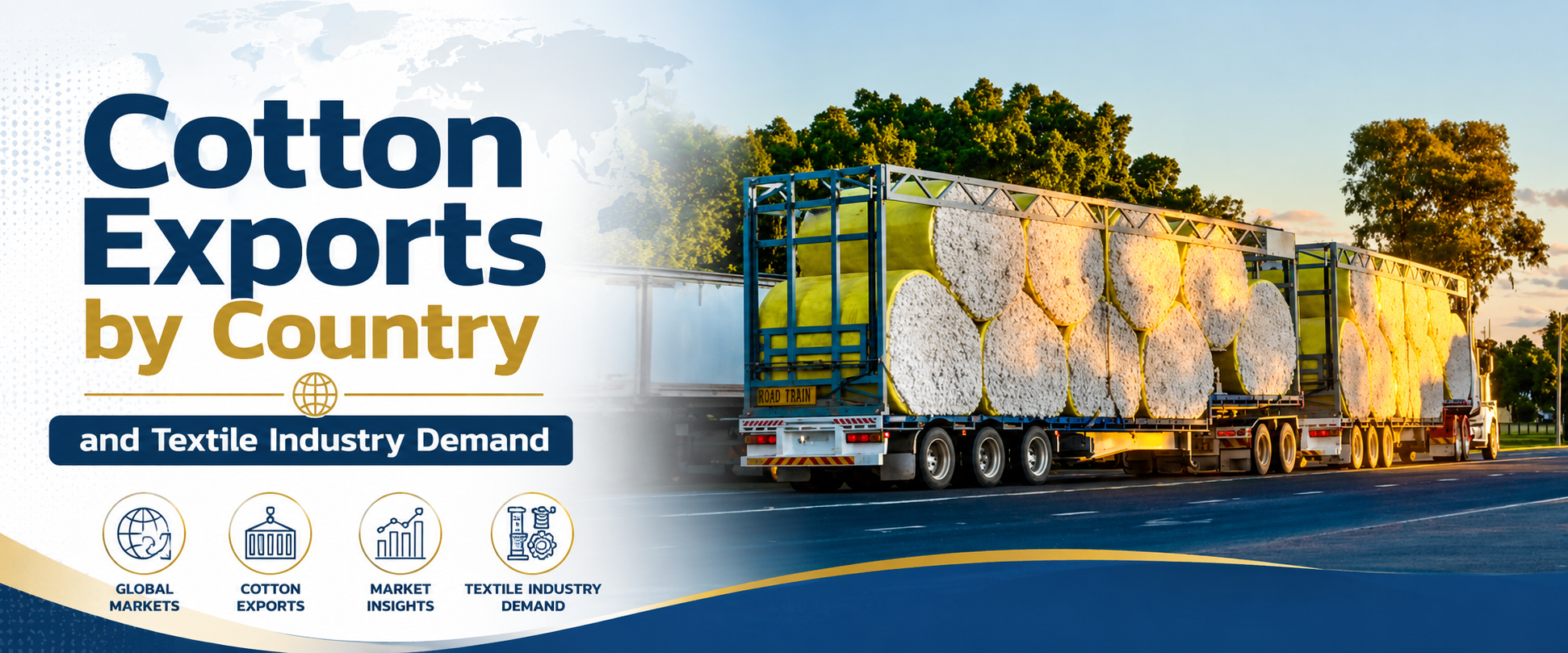
The international trade of cotton is essential for the rapid growth of the textile and garment industry. Cotton is one of the most expensive natural fibers used in making clothes and domestic and industrial textiles. As the demand for sustainable and high-quality cotton-based products continues to increase rapidly in the world, most nations have increased their efforts to export cotton to meet the needs of foreign markets. By 2025, among the world’s largest exporters of cotton will be nations like China, India, the USA, Brazil, and Pakistan. The textile sector makes billions of dollars for the world’s economy.
Understanding knowledge export by countries will help businesses to know good suppliers, new markets, and possible export opportunities. In this guide, we will discuss in detail the top cotton exporting countries and the factors that are driving the demand for cotton in these countries.
Cotton in the global market plays an extremely vital role in the textiles and apparel market as it connects the farmers, producers, exporters, and retailers all across the globe. Despite the intense competition from synthetic fibers like polyester, cotton continues to be one of the most popular natural fibers used, with a nearly 25 percent share of the world’s fiber consumption.
Cotton-producing countries include China, India, Brazil, the U.S., and Pakistan, among others, while some of the biggest consuming countries include China, India, Bangladesh, Vietnam, and Turkey because of their highly developed textile industry. As per USDA estimates, the world cotton production is estimated at 116 million bales, and world cotton mill use will stand at 121.8 million bales, driven by the high demand in the textile industry. The reduced stockpile in the world is also expected to bolster cotton prices.
There are numerous factors that impact the global market of cotton, including weather, trade, sustainability, and changing consumer preferences. Weather-related issues such as droughts and infestations can lead to reduced output, while changes in international trade impact the level of exports and price levels.
However, numerous fashion companies opt to use eco-friendly cotton to meet the rising demands from consumers for eco-friendly products. Even though cotton has competition from man-made products, it is appreciated because of its great comfort and biodegradable properties. As a result of population growth and higher demand for clothing, it can be expected that cotton will still play an important role in the global textile manufacturing process.
|
Country |
Estimated Cotton Exports(2025/26 Marketing Year) |
Global Position |
Key Export Markets |
|
Brazil |
14.3 million bales |
Largest cotton exporter |
Vietnam, Pakistan, China |
|
United States (USA) |
12.5 million bales |
Second-largest cotton exporter |
Vietnam, Pakistan, Turkey, China |
|
Australia |
4.8 million bales |
Third-largest cotton exporter |
China, Indonesia, Vietnam |
|
India |
1.0 million bales |
Major cotton producer and exporter |
Bangladesh, Vietnam, China |
|
China |
0.2 million bales(estimated) |
Major producer with limited exports due to high domestic consumption |
Limited exports; mainly neighboring Asian markets |
Source: https://www.fas.usda.gov/data/production/2631000
Brazil: It is the largest exporter of cotton in the world, primarily selling it to the Asian countries of Vietnam, Pakistan, and China, owing to its significant share in the market because of good-quality fiber, competitive prices, and consistent supply.
USA: It was the largest exporter of cotton after Brazil and established supremacy in the market owing to its superior quality fiber and consistent supply.
Australia: As the third-largest exporter, it is known for producing the highest yield per acre globally.
India: One of the largest producers; the only drawback is that its domestic consumption of cotton is very high, and it consumes most of it domestically.
China: This country is also considered a major player as the world's largest consumer as well as major producer of cotton.
|
Indicator |
2026 Estimate |
Source |
|
Global cotton consumption |
120 million bales |
|
|
Projected world cotton mill use (2026/27) |
121.8 million bales |
Economic Research Service (USDA) |
|
Countries accounting for most cotton mill use |
China, India, Pakistan, Bangladesh, and Türkiye (~77%) |
|
|
Largest cotton exporters |
Brazil, United States, Australia |
|
|
Largest cotton importers |
Vietnam, Bangladesh, China |
The cotton export market is influenced by global textile mill needs, overseas economic growth, and the availability of inexpensive synthetic fibers, for instance, polyester.
Below are some key factors driving global cotton export demand.
The strong expansion of the fashion industry has tremendously increased the demand for raw cotton. Almost daily, every minute of every hour, the fashion industry launches new collections, keeping consumer demand high. This brings increased necessity, pressure, and opportunity for textile manufacturers to import large quantities of cotton to match global demand more than ever.
This is also coupled with the fact that when people's income and power increase, especially in growing economies, they are eventually motivated to purchase more. This led to an increased demand for manufacturers to import more cotton.
The unceasing growth in the production of textiles in developing nations like Bangladesh, Vietnam, Pakistan, and Turkey has generated a huge need for cotton imports. These nations have spinning mills, weaving plants, and garment industries that consume cotton round the clock. With this kind of production increasing day by day, there is a constant need for cotton imports to sustain such activities.
Sudden changes in government policies and shipping regulations can disturb trade routes and help certain exporters that offer better transport networks. In addition, agricultural subsidies and favorable trade policies play a significant role in boosting the competitiveness of the countries producing cotton in the international market. Cotton cultivation forms a solid base for textile industries around the world.
The growing population has a direct impact on clothing demand. Growing economies and rising consumer spending have influenced higher spending on fashion and apparel products. This led to the rapid expansion of the international cotton trade.
Cotton is widely used in making bed sheets, pillows, towels, blankets, and curtains. As the home textile industry grows, the demand for cotton has also increased. This is because cotton is soft and offers excellent breathability, making it the most important fiber for home textiles.
Fluctuations in US Dollar rates have a direct impact on cotton exports, as a weakened dollar results in cheaper American cotton.
With the increase in the demand for natural fibers among buyers globally, there is an enormous potential for doing business in the global cotton industry. Those companies that know about the trends of the market and establish a stable supply chain are in a better position to capitalize on the increased global demand. There are many countries in Southeast Asia, some countries in Africa, and Turkey, which have a very great demand for cotton for their textile mills to keep operating.
The growing popularity of organic cotton and sustainably produced textiles has also opened new market segments. International buyers are increasingly seeking suppliers that comply with environmental standards, responsible farming practices, and quality certifications. Exporters investing in sustainable production methods are likely to gain a competitive advantage in premium markets.
Consumers are increasingly becoming eco-conscious with awareness of environmental sustainability, seeking suppliers that comply with environmental standards and are ready to pay a premium price for verified regenerative and organic cotton.
Moreover, through technology and advanced methods of agriculture, biotech seed investments have boosted the production of cotton crops while conserving water resources. B2B platforms have enabled global buyers and suppliers around the world to come together and provide new ways of conducting business.
The future outlook of the global cotton trade looks good as there is an increase in demand for sustainable and natural fibers. The rise in environmental consciousness, growth in textile industries, and consumer inclination towards eco-friendly products will enable steady growth in the global cotton trade in the coming years. Cotton is expected to be one of the key raw materials for the global textile industry despite stiff competition from synthetic fibers.
Brazil and the USA remain the largest global exporters, with India emerging as a key player with advanced farming, technological advancement, and better crop yields, expected to surpass exporting cotton giants like China.
This technological advancement is about to change the entire global trade with innovative irrigation systems, biotechnology, and better seed varieties, which are helping farmers more than ever to increase productivity, all the while lowering water consumption and production costs.
Manufacturers adopting sustainable and responsible farming practices are not only respected but also more businesses want to deal with them. Unpredictable weather and water shortages present enormous challenges. However, manufacturers and farmers are adopting modern farming practices. They invest in technology that produces better crops with less water. Because of this, the agricultural industry continues to flourish despite the disadvantages.
Overall, the future outlook of global trade remains positive and promising, with growth in the fashion, apparel, and home textile industries. In 2026 and beyond, businesses are using trade data and market intelligence reports to analyze trends and market demand and make better decisions to expand internationally.
With continued expansion of the international cotton trade, companies need access to reliable market information so that informed decisions can be made regarding sources and investments. Regardless of whether you are an importer searching for reliable sources, an exporter looking for new markets, or a manufacturer requiring quality raw material, having access to such information is important for sustained growth.
TradeYao is the leading trade data provider offering market insights and trends. The platform provides 90% accurate data from official trade databases and assists companies in making well-informed decisions. This information is helpful in identifying new opportunities in the world cotton market. Such information allows companies to take advantage of market trends by utilizing the appropriate tools.
The demand for cotton will continue to grow despite market and financial pressures, environmental and climate changes, and increasing competition. Businesses that continue to evolve with changing times and adopt modern farming practices and utilize technological advancements will continue to grow, whereas businesses that don’t will lag behind and become obsolete. TradeYao will continue to serve businesses by providing valuable data insights for better decision-making.

The international trade of cotton is essential for the ra...
Read More
As one of the leading exporting nations in the world, Fra...
Read More
The United States is one of the most powerful export regi...
Read More